
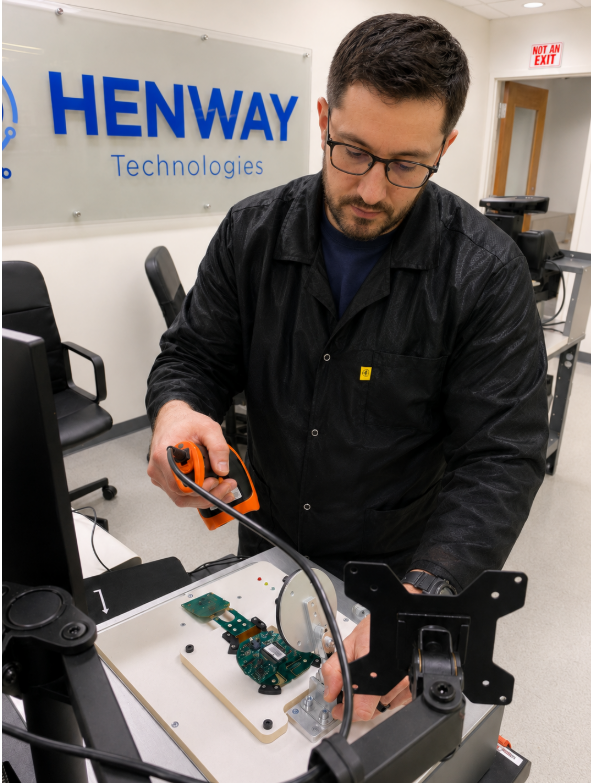
Testing is really a question of where you want problems caught: at Henway, during your final product test, or after the product reaches your customer.
If your team is going to install each PCB into a finished product, power it up, and run a full product test before shipping, then full functional testing at Henway may not be necessary.
In that case, it may be enough for us to check the things your team is less likely to catch during final assembly, such as power rails, current draw, or other board-level issues that are not obvious from visual inspection.
If your team is going to install boards and ship products with minimal testing, then Henway should probably check the things your team is not going to check. Most of the time, these checks can be kept simple and usually take two to five minutes per board.
If you want your team to receive boards that can be installed without checking the board at all, then we should talk through a more complete test. That may mean exercising all of the board’s features, or simulating enough of the final product behavior to give everyone confidence before the boards leave Henway.
Level 1: Basic PCB Assembly Checks
Some boards have areas that we feel better verifying electrically, not just visually, before they leave Henway.
These are usually simple checks. We can often include them without turning testing into a major line item on the quote.
For example, we once had a customer report that a board was “dead on arrival.”
They shipped it back to us. We had the schematic, so we powered it up and checked the rails. Within a few seconds, we found that the 5V rail was at 0V. We replaced the main switcher IC, and the 5V rail came back alive.
That was not a complicated test.
It was applying power, checking the rail, checking current draw, and seeing if the power supply section was alive.
Customers are usually understanding when a new issue appears. Patience drops quickly, on both sides, when the same issue shows up on multiple orders.
In this case, to avoid a customer receiving another board with a dead 5V rail, we added a 100% voltage-rail check to that build’s production instructions. We will keep checking that rail on future builds.
We did not need to create a big fixture. We did not need to make the customer write a test plan.
We simply changed the instructions so that boards from that build would not leave Henway again without that rail being checked.
That is what we mean by a basic PCB assembly check.
It does not prove the entire product works, but it helps catch a known board-level issue before the customer sees it again.
FYI: Power rails are low hanging fruit and a good place to start because power supply sections typically include fine pitch parts surrounded by larger components, inductors, capacitors, diodes, regulators, that can suck heat away and cause soldering issues.
Also, if a board draws too much current, has a missing rail, or has a rail that is struggling, that is often a useful clue that something is wrong.
Testing the power supply is a simple check that can catch a wide range of problems in seconds.
Hardware Block Checks
Sometimes a simple 10- or 20-second power check is not enough.
If there are important sections of the board that would be painful to troubleshoot later, we can build a short test around those specific hardware blocks.
For example, it is not unusual for a customer to have a PCB that cannot be fully checked until after a long mechanical installation process involving epoxy, sealing, or customer-specific equipment.
By the time the product is assembled far enough to test, a bad board could create a lot of wasted labor and scrap.
In cases like that, a simple rail check may not be enough.
We may need to exercise more of the board before it leaves Henway.
That could mean programming the processor, using test firmware, communicating with sections of the board, and verifying things that are difficult to inspect visually.
That still is not a full product test.
The board is not installed into the customer’s complete system, so some electrical paths and final product behaviors are still not covered.
But it gives both sides more confidence that the important hardware blocks are assembled and responding correctly before the customer spends time installing the board.
This level is a good fit when you want more confidence than a basic power check, but you do not need Henway to simulate the entire finished product on every unit.
Full Functional Testing
The most complete option is a test that exercises the whole board or finished product.
This may require fixtures, harnesses, custom test software, or Henway doing the entire box assembly and then walking through documented test steps.
This kind of test can be very useful.
But if your team is going to install every PCB into the finished product, power it up, and fully test it before shipping, then a full Henway functional test may be redundant.
However, if your team is going to install the board, close the enclosure, and ship the product without much additional testing, then we should talk about a complete test before the boards leave Henway.
A Note on Programming and Testing Cost
Programming may only take a minute, and we rarely charge much for programming by itself.
Checking a voltage rail may also only take a minute. When that kind of check is simple and tied directly to PCB assembly quality, we often treat it as part of an internal confidence check rather than a separate testing project, and we often do not charge separately for it.
Hardware block testing and functional testing are different. Those are usually quoted based on the estimated time required to run the test, the equipment involved, the documentation required, and what should happen if a unit fails.
A one-minute programming step is different from a five-minute hardware block test or a ten-minute full product test.
If you have questions about testing, reach out. We can look through the design together, suggest a practical starting point, and improve on that test process as units are produced so repeat issues do not keep showing up in later builds.