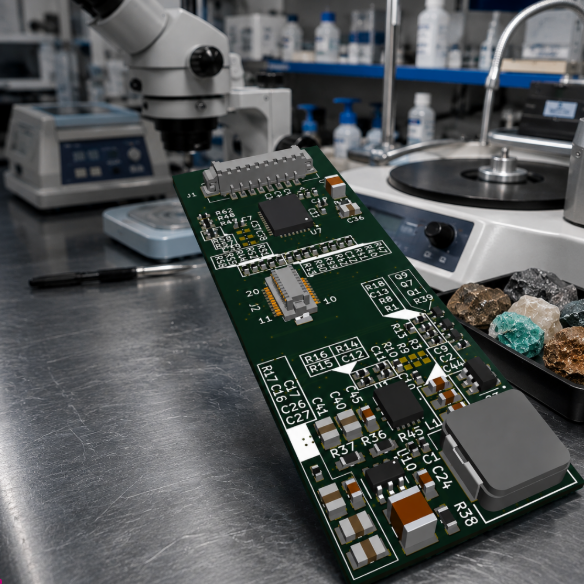
A customer came to us with a compact battery-powered handheld rock polishing device.
The product needed a small BLDC motor, LED user feedback, rechargeable battery, and a control board that could fit inside a very tight handheld enclosure.
The customer was an established small business with an existing product line and an overseas supplier.
They wanted to move from a small brushed DC motor to a brushless DC motor. The change had the potential to save about $50 per unit at production quantity. Their current supplier was not willing to make the change for a brushless DC drive circuit so the customer had to look elsewhere for a solution.
So the customer came to Henway to design a new electronics package that could fit inside the existing housing, and add a few wish-list features along the way.
Fitting everything inside the existing product was the hard part
During the first few meetings, the customer showed us the 3D CAD models.
It was obvious pretty quickly that space was going to be very tight.
The new design needed brushless motor control, battery management, LED feedback, safety features, and enough IO to support the user interface. But for confidential reasons, we also had to work within a low pin-count microcontroller.
So this project became one of those classics. How do we fit five pounds of electronics into a three-pound sack?
The parts we used
We selected a compact brushless DC motor driver IC from TI with hall-effect sensor feedback.
We also used a GPIO expander to give the design the extra IO it needed without adding a second processor.
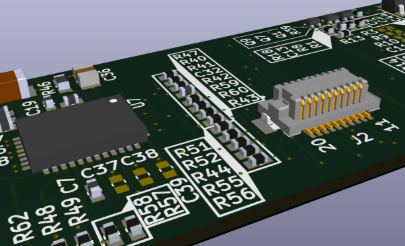
The design required two stacked PCBs inside the existing housing. Board-to-board spacing mattered a lot. We used low-profile board-to-board connectors available in stacking height options in 0.5mm increments, which allowed us to dial in the PCB spacing perfectly. That sounds like a tiny detail, but in this product, one millimeter can be the difference between “fits perfectly” and “the enclosure will not close.”
Proving the motor before committing to the final PCB
We did not want to design a custom PCB and then discover that the motor driver did not meet the customer’s expectations.
So before locking in the final board design, we bought evaluation hardware for the motor driver and drove it with the actual processor we planned to use in the final design.
Then we built a test setup package and shipped it to the customer so they could install the new motor in their housing and evaluate the torque, closed-loop speed control, audible noise, vibration, etc.
Where the project is now
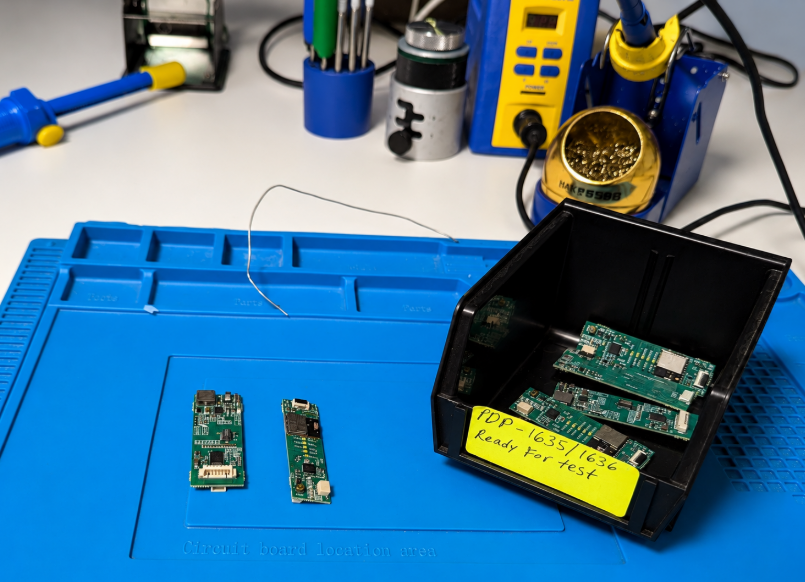
At the time of this article, the first boards are coming out of assembly and moving into block testing.
The first goal is to smoke test the boards, load the motor-driver configuration, and ship the customer a sample they can use for mechanical fit and motor testing.
We also developed a PC terminal interface so the customer can vary motor speed and adjust control parameters without reflashing the board every time.
That buys us time to keep finishing the rest of the firmware while still letting the customer start hands-on testing with real hardware.
Planning production
When the project moves into production, the customer will ship the plastic housings to Henway.
We will assemble the circuit boards, install the electronics into the housings, connect the battery and other off-board components, and package the finished subassemblies for return shipment.
From there, the customer can complete the final assembly without needing to manage PCB assembly, electronics installation, soldering, or board troubleshooting on their own.
The plan is to build and ship these in batches of 1,000 assemblies at a time.
What this project included
This project involved:
- Brushless DC motor control
- Compact stacked PCB design
- GPIO expansion
- Rechargeable LiPo battery
- Complex LED user feedback
- Over-temperature protection
- USB debug interface
- KiCad PCB design
- Embedded firmware development
- Prototype build and test support
The point
We help customers take products that already have a business case and turn the electronics into something smaller, cleaner, more manufacturable, and ready for the next production step.